


LPR Presents
Oct
15
with Windhand

Wed October 15th, 2025
7:30PM
Pioneer Works
Minimum Age: All Ages
Doors Open: 7:00PM
Show Time: 7:30PM
Event Ticket: $35
Day of Show: $40

Ticketing Policy
All ticket sales are final. No refunds or exchanges. Physical photo ID required for all shows with age restrictions – no exceptions.
When an event sells out, fans who missed out on tickets can join the Waitlist for a chance to purchase tickets from someone who can no longer attend. Joining the Waitlist does NOT guarantee entry to the event, please do NOT arrive at the venue unless you are contacted about tickets becoming available.
Joining the Waitlist:
• If you’re looking for a ticket to a sold out show, add your info the the corresponding Waitlist.
• If a ticket becomes available, you’ll be notified and your credit card will be charged.
Listing Your Ticket on the Waitlist:
• If you already have a ticket, you can list it on the waitlist through the “My Tickets” page.
• Once we find a buyer for your ticket, you will be notified.
YOB

“Slow is fast,” says Mike Scheidt, singer, guitarist, and creative nucleus of the Oregon-based doom metal trio YOB. It’s a concept that speaks to both the immense propulsion of their megalithic compositions and the way their artistry has patiently unfurled across their 25-year tenure. Change and revelation take time. You can’t snap yourself into epiphany and you can’t force yourself into another shape. You have to trudge. It doesn’t mean you’re failing. You persevere through the muck or you stop and you sink. There is no third way.
YOB’s music spreads across a plain where vast weather systems converge. Since sharing their first demo in 2000, the band has slowly, graciously gathered a devoted audience into their planetary orbit. Together with bassist Aaron Rieseberg and drummer Dave French, Scheidt tethers pendulous riffs to sky-flung vocals, sinking deep into the trenches and then cresting through the clouds. From the stoner rock ripples of their 2002 debut Elaborations of Carbon through the cavernous echoes of 2018’s Our Raw Heart, YOB wield their totalizing gravity to bore into the light that hides in everything.
Scheidt was reared on punk and metal in the eighties and nineties: parallel outsider ecosystems that lent language and dimension to deep feelings of unbelonging. “Music became for me what I think it is for everybody: an anchor,” he says. “It’s something that soothes; it’s something that lets you feel the intensity of anger without the damage of anger.” He turned toward doom after seeing Cathedral perform in Portland in the early nineties. “I was hanging out in the back. Then Cathedral started playing and it took maybe ten minutes for me to go from the back of the room to wedging myself against the front of the stage,” Scheidt remembers. “It changed my life. Before then I was in punk bands. After that, I started to play slower and lower.”
Toward the end of the nineties, Scheidt started writing songs in the stoner doom tradition of Black Sabbath and Sleep. He dubbed his new project YOB and submitted its first demo to stonerrock.com, one of many online musical communities that sprung up during the explosion of home internet service at the end of the millennium. At the time, Scheidt was busy parenting his three young children and didn’t expect the recording to lead to much. “I just submitted the demo because I wanted to be a part of the community,” says Scheidt. “There was no idea of anything beyond that. Life was very busy and I had other priorities. Everything that came afterwards was surprise after surprise after surprise.”
A warm reception on stonerrock.com sparked label interest, and YOB officially debuted with Elaborations of Carbon, a refinement and expansion of the blues-based stoner rock of their demo. The psychedelic romps of Catharsis followed in 2003, while 2004’s The Illusion of Motion further deepened YOB’s absorbing weight. In 2005, The Unreal Never Lived nudged Scheidt’s devotional practices closer to the forefront of his lyrics. “I’m a longtime practitioner of Buddhism with a nod to Advaita Vedanta,” he says. “I’m a skeptical practitioner in the sense that certain beliefs are either things I don’t grab onto or I take a slow approach. But it was all very much an attempt to solve my own suffering and connect to a deeper world than the one I was raised to believe in.” The album’s title references a quote from Sri Nisargadatta Maharaj, a Hindu spiritual teacher whose work found a wide audience among Western seekers with the 1973 publication of the book I Am That: “The real does not die, the unreal never lived.”
“It’s just about getting to know reality as it is before you can think about it,” says Scheidt of his spiritual practice. “It’s already there. Whatever’s true is true right now, regardless of what we say or believe about it.”
Following two monthlong tours in the middle of the 2000s, YOB disbanded in 2005. News of their breakup drew the curiosity of new listeners, and their audience grew through word of mouth during four years of dormancy. By the time YOB regrouped in 2009, their records were selling better than ever, and they were playing to bigger and bigger rooms. A new chapter began with 2009’s The Great Cessation. YOB worked steadily, slowing the pace of their output and growing their audience organically with more extensive touring. Their 2011 album Atma — named after the concept of the truest, most expansive self in Hinduism and Buddhism — earned a nod on SPIN‘s top 50 albums of the year.
In early 2012, YOB opened for Tool on a string of East Coast shows, where they learned to fill arenas with their singular galactic sludge. Two years later, the 2014 album Clearing the Path to Ascend notched a new peak in the band’s snowballing acclaim. “I remember getting off a plane to play sold out shows at St. Vitus in Brooklyn, and my phone was blowing up that we had got metal record of the year in Rolling Stone,” says Scheidt. “I was like, what is all this about? It was something you can’t ask for. It was just there.”
Anyone who’s gone to a YOB concert knows the distinct quality of attention the band commands. To see them live is to surrender completely, awash in pulverizing sound. The sheer mass of the music dislodges consciousness from its habitual patterns; dissolve into YOB and you’ll find yourself rewritten upon surfacing.
“The crowd and the band are not two things,” says Scheidt. “Over time, playing live has become much less about escape for ourselves and much more about the community of people that have brought us there. Our intention is to offer a space where all of us together can come up for air from the daily struggle. Our music is medicine for us. If it’s that for anyone else, it’s an immense honor.”
Onstage, French, Rieseberg, and Scheidt continually reforge songs from deep in YOB’s catalog. Compositions evolve and grow along with the band, taking on lives of their own over time. “We’re a better band than when we started. We’re a clearer band. We’re much better at focusing within the relaxation that comes from deep water,” Scheidt continues. “Dave is a MacGuyver multi-instrumentalist and an immensely skilled human who seems to have a solution to any obstacle that arises. Aaron is a multi-instrumentalist as well. A deep student of the bass, he whips up thunder with ease, calling on decades of experience as an ever-reaching, forward-thinking musician. Anything I do is inseparable from the wisdom, knowledge, and skills of Aaron and Dave. Together, we are YOB.”
Windhand
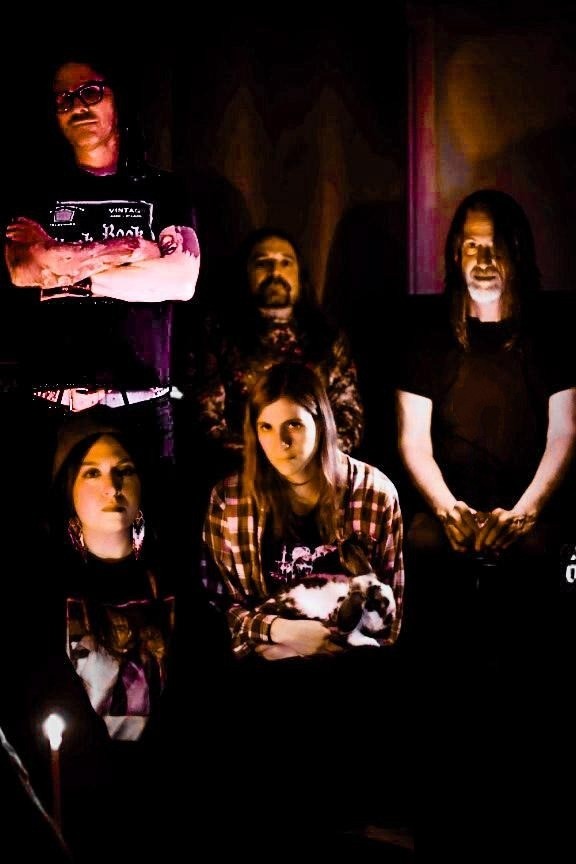
Richmond, VA heavyweights WINDHAND mark their arrival on new album, ‘Eternal Return.’ Boosted by Garrett Morris’ consistently cool riffs—forged at the crossroads of Iommi’s otherworldly import and Kurt Cobain’s spontaneous precocity—powered by Ryan Wolfe and Parker Chandler’s groove-laden rhythms, and propelled by Dorthia Cottrell’s smoky yet wistful vocals, WINDHAND’s new album is a two-step jump for Richmond’s finest purveyors of the psycho-actively heavy. Adorned by Arik Roper’s (Sleep, High on Fire) impressive cover art, ‘Eternal Return’ not only looks the part of WINDHAND’s artistic growth but sounds the part.
For the new album, ‘Eternal Return,’ WINDHAND wrote throughout the winter. Out of the songwriting sessions, “Halcyon,” “Grey Garden,” “Red Cloud,” and the monstrous “Eyeshine” emerged as the heaviest tracks, while “Pilgrim’s Rest,” “Diablerie,” and “Feather” embodied the more reflective side of WINDHAND. The juxtaposition of heavy, psychedelic, and pensive is less like Black Sabbath and Sleep and more like Soundgarden and Veruca Salt. But the namedrops aren’t absolute so much as signals of WINDHAND’s ability to stretch beyond genre confines. ‘Eternal Return’ is a complete life-to-death journey.
Thematically, that’s exactly what WINDHAND were aiming for on ‘Eternal Return.’ As unplanned things go, it’s an observation of as well as a reflection on life’s ups and downs, joys and sorrows, beginnings and ends. Between ‘Grief’s Infernal Flower’ and ‘Eternal Return,’ WINDHAND welcomed new life, survived lineup changes, and mourned unexpected death. The songs and song ordering are the direct result of those experiences. Where “Halcyon” is assured in its opening of ‘Eternal Return,’ the closing track “Feather” is its funeral march.
For ‘Eternal Return,’ WINDHAND brought Endino back to the fold. Together, they spent two weeks recording at Soundhouse Recording in Seattle. Described as “smooth” and “intense,” the sessions with the famed producer were just what WINDHAND wanted. Endino also understood the group’s artistic progression, chiefly the admiration of and blending in late ‘80s/early ‘90s grunge. Out of it all, WINDHAND continued to refactor and refine their vision of heavy. A new era of psychedelic heaviness is upon us with WINDHAND’s genre-blurring ‘Eternal Return.’ Sweet, fuzzed-out oblivion has never been closer…
WINDHAND are:
Dorthia Cottrell – Vocals Garrett Morris – Guitar Parker Chandler – Bass Ryan Wolfe – Drums